

Strengthening Retail Performance Before Activation

Why POP Display Validation Strengthens Retail Execution
Point of Purchase (POP) display validation plays a critical role in delivering strong retail performance. While concepts are developed digitally, retail displays ultimately succeed in physical stores, where shopper interaction, competitive context, and real-world conditions influence engagement.
When evaluated at full scale within a realistic retail environment, displays gain clarity, impact, and alignment before production begins.
At Hughes Decorr, POP display validation connects digital development to in-store performance, helping brands move forward with greater confidence and execution certainty.
Validating Displays in a Real Retail Environments
Retail performance is shaped by variables that can only be fully understood in context, including:
- Shopper flow and path-to-purchase approach
- Distance visibility and message sequencing
- Structural presence at full scale
- Competitive adjacency
- Multi-angle sightlines
Virtual renderings support creative review. Physical validation supports retail performance.
TIn-store display validation allows teams to confirm that messaging communicates in the intended order, that primary claims are clearly visible, and that structural design and graphic execution work together to create presence, stability, and clarity at shelf.
Structured POP display validation strengthens execution before production investment is finalized, replacing assumptions with measurable insight.
The Hughes Decorr Retail Innovation Lab
The Hughes Decorr Retail Innovation Lab is a permanent, full-scale retail display validation facility designed to simulate real retail conditions.
This controlled retail simulation environment supports:
- Full aisle and endcap configurations
- Competitive display testing through side-by-side placement
- Walk-through evaluation from a shopper’s perspective
- Real-scale structural and messaging validation
Because the environment is purpose-built and permanent, validation can be conducted consistently across programs and retail formats.
Hughes Decorr clients assess how their displays perform independently and in direct comparison to competitors before committing to production.
Competitive Display Testing in Context
Retail environments are dynamic and visually dense. Competitive display testing ensures programs stand out with clarity and intention.
Within the Retail Innovation Lab, brands can evaluate:
- Relative visual dominance
- Brand blocking effectiveness
- Messaging clarity beside adjacent programs
- Structural impact compared to competing displays
Evaluating displays in a simulated retail environment provides clearer insight into visibility, message clarity, and competitive presence before rollout.
AI-Supported POP Display Validation and Heat Mapping
Hughes Decorr enhances physical display validation with AI-supported shopper behaviour modelling.
Predictive modelling and heat mapping provide insight into:
- Where shopper attention is most likely to land
- High-engagement zones across the display
- Areas that may benefit from refinement
- Gaze sequencing and message flow
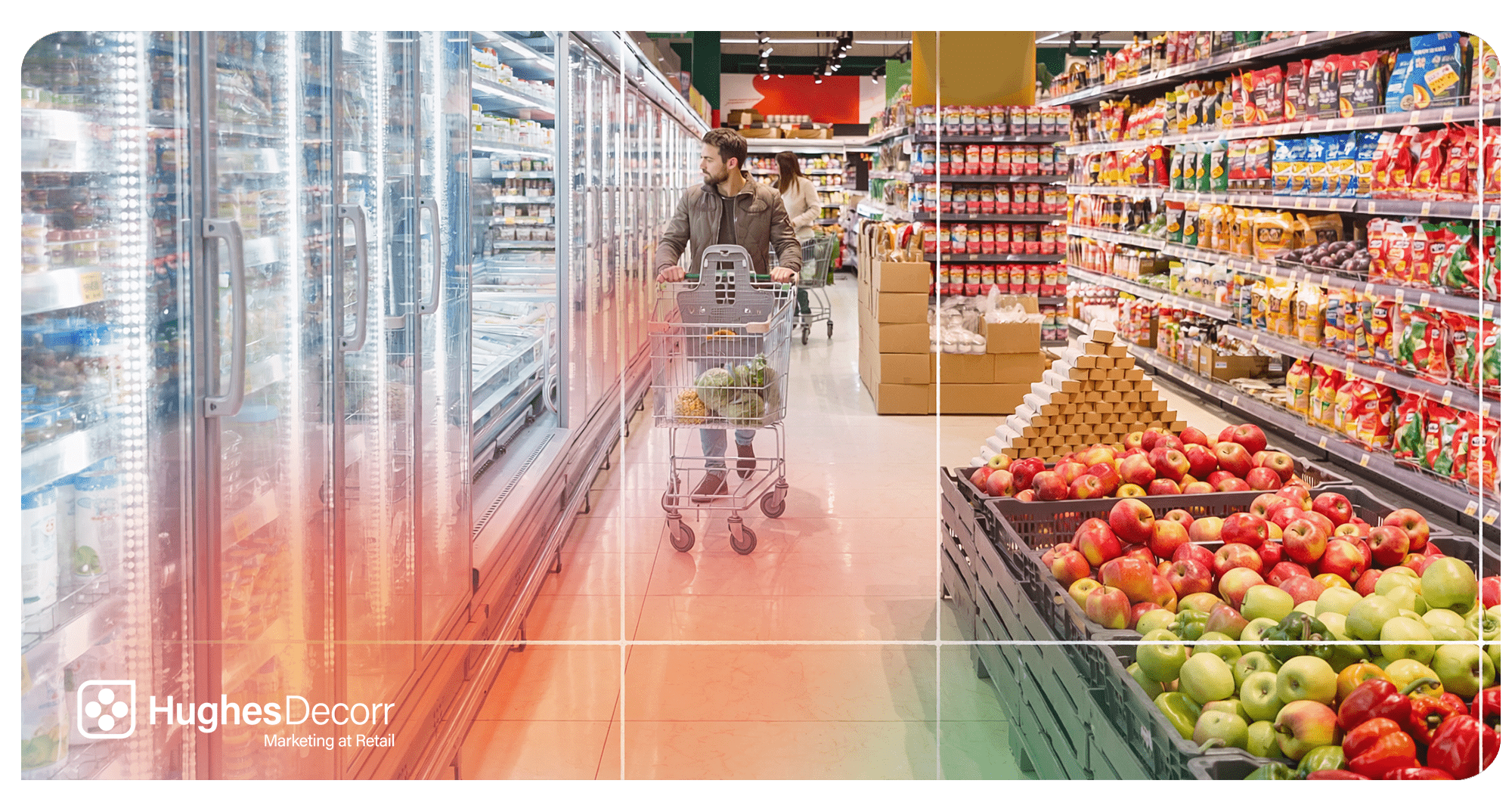
This combination of physical simulation and data-informed analysis provides deeper validation and supports confident retail decision-making.
A Collaborative Retail Validation Environment
Hughes Decorr’s Retail Innovation Lab functions as a collaborative decision space.
Our clients can use the adjacent workspace to conduct structured review sessions, align cross-functional stakeholders, and refine execution in real time.
This hands-on validation approach allows marketing, sales, and shopper marketing teams to experience the display as shoppers would, turning internal opinion into aligned, performance-driven decision-making before production begins.
From POP Display Validation to Retail Confidence
Effective retail execution is strengthened through structured in-store display validation that reflects real retail conditions.
By conducting comprehensive POP display validation before production, brands gain:
- Clearer message hierarchy
- Stronger competitive positioning
- Greater rollout consistency
- Improved in-store performance
At Hughes Decorr, POP display validation is not a final step, it is part of a disciplined approach to retail execution. Displays are evaluated at full scale, in competitive context, and with data-informed insight before production begins.
When programs are validated in the environment where they will ultimately perform, decisions shift from subjective interpretation to objective evaluation.
Retail performance begins long before a display reaches the store floor.
Ready for Retail Execution
If your POP display strategy has not yet been validated for real retail performance, there may be opportunities to improve execution and shopper engagement.
Let’s talk about how we can help you evaluate messaging hierarchy, print execution, and real-world performance to support stronger retail outcomes.

Stay Connected With Us